
 Back to News
Royal Medical Corps at FSL

It may be surprising to many pupils and staff to learn that Friends’ School was under army occupation during the Second World War between 1940 and 1941. The occupying forces were not those of the enemy but the British Army, specifically the 206th Field Ambulance of the Royal Army Medical Corps.
Archive documents show that the principal of FSL, Mr John Douglas, was officially notified on 4 July 1940 by the Ministry of Public Security at Stormont that the premises were under review for adaptation as a supplementary military hospital. Two weeks later a RUC constable served formal notice on Mr Douglas that the school buildings and lands had been requisitioned and military occupation would commence later that day.
The Douglas family, who resided on the school grounds and were due to depart the following day for a holiday at Bantry Bay, were abruptly relocated. Instead of leaving for a holiday they were instructed to vacate the school taking its contents with them including every desk and chair.
An account from the school archive, written by Moira Douglas, daughter of the Principal, describes the upheaval and indicates the location where pupils would be taught for the incoming year. Several properties in Lisburn were acquired to enable the school’s activities to continue into the 1940/41 term.
Moira wrote:
“If the sky fall, we shall catch the larks” says the old proverb…Middle House was evacuated within the 24 hours, since the R.A.M.C. officers had chosen it for their quarters. It took weeks to clear the school. Each day saw a long trail of army trucks roaring up the Big Dive, loaded with desks, chairs, crockery, saucepans, heading for one of the many impromptu storehouses which had magically opened their doors to help. The army helped too when they saw that this was the quickest way to get us out. I can remember long weary days spent packing china in that strange dark cupboard which stretches way back under the back stairs.
Moira continued with an insight into the new school arrangements:
Gradually, a pattern for the autumn term began to take shape. The Boys’ Hall, Sloane House, the Friends’ Meeting House in Lisburn, were to be our classrooms. Ardfallen was offered as a haven for some of the boarders, but was obviously too small for everyone. Then it was that my parents met Mrs. Blizzard. Negotiations were soon under way for the use of Larkfield, a large, friendly old house on a large, tangled old estate at Dunmurry.
We had caught our larks, our school reassembled that September for what must have been one of the strangest years in its history.
The 206th Field Ambulance moved into the school along with a unit of the Army Service Corps, used to secure and garrison the school, a total of around 200 men. It seems that during the winter of 1941 the army’s biggest enemy was the cold. Ten trees were felled along with lengths of wooden fencing, all used for firewood. The baffles and fittings of the heating ranges were damaged owing to them being used at ‘full draft’ with the stove doors open in an attempt to maximise heat. Added to this damage, water pipes froze, then burst.
So, how many lives were saved by this new hospital at FSL? The answer – not one. In fact, for the full year that the school was requisitioned as a hospital only one patient was ever admitted, in Moira’s words:
The end of the Larkfield story is old history now. During its twelve months of life as a military hospital, the old school had one patient, – an old scholar, suffering from mumps or measles or some such unwarlike complaint. Thanks to his report, a deputation to the authorities finally convinced them that the buildings were better suited to housing schoolchildren than one hospital patient every twelve months.
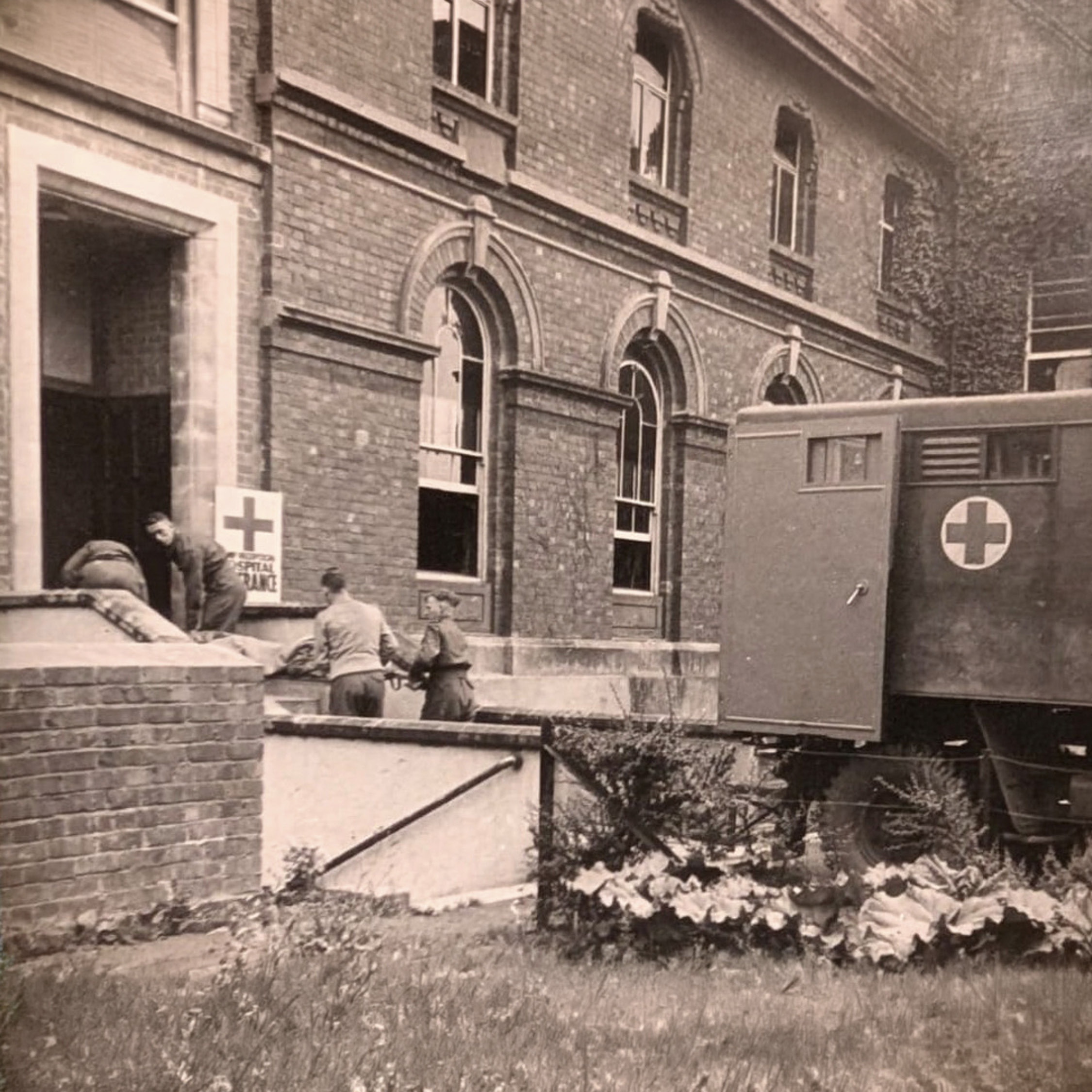
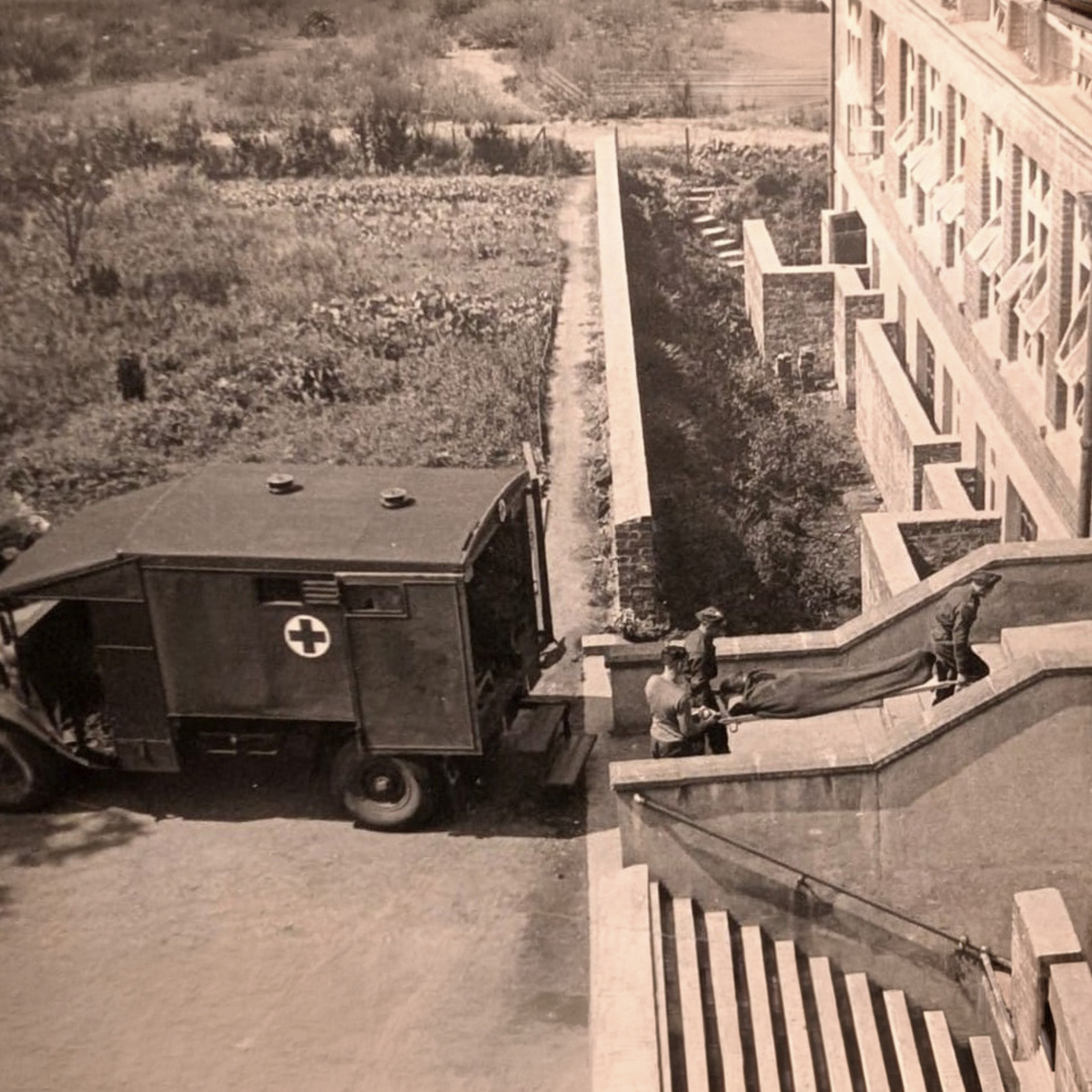
A set of photographs in the archive documents the military occupation of the school. Two of these images lend themselves to a then/now treatment. Upon examination, it becomes apparent that they were staged. Both photographs depict a patient being transferred into the school by military ambulance. We know from Moira Douglas’ account that there was only ever one patient who in all likelihood simply walked in for treatment with a complaint such as mumps. No photographer is visible in either shot, suggesting that one photograph was taken and the scene held in situ while the photographer ran to the Colonel’s (Principal’s) office to re-take the scene from an elevated angle.
Perhaps all part of a scheme to make the hospital appear busier than it actually was, perhaps just exercise for the photographer!!